
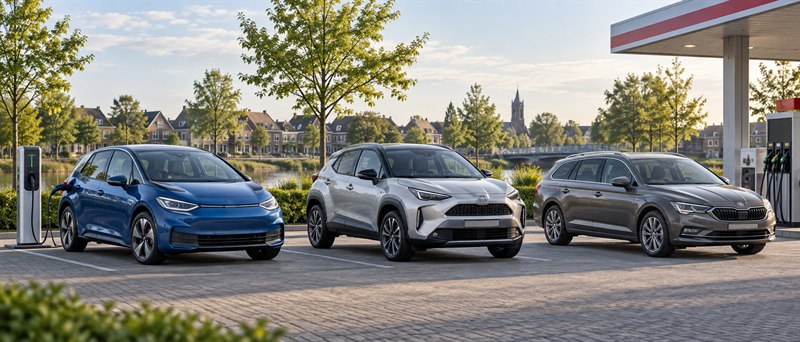
The right powertrain depends on where you drive, where you park and how often you can charge. A fully electric car can be excellent for daily travel with reliable charging. Petrol remains straightforward for unpredictable journeys. Hybrids sit between them, but a regular hybrid and a plug-in hybrid solve different problems.
Know What You Are Comparing
A fully electric car runs only on battery power and must be plugged in. A petrol car uses a combustion engine. A regular hybrid combines a petrol engine with a small battery and electric motor; it charges itself while driving and cannot normally be plugged in. A plug-in hybrid has a larger battery that you charge externally, plus a petrol engine for longer journeys. Check the exact model: a mild hybrid generally offers less electric assistance than a full hybrid.
Fully Electric Cars
Advantages
- No exhaust emissions while driving, with quiet operation and smooth acceleration.
- Fewer routine engine-related service items, such as oil changes and exhaust repairs.
- Running costs can be attractive when you can charge at home or at a reasonably priced workplace charger.
Drawbacks
- Charging takes longer than filling a tank. Public charger availability and prices vary by location and provider.
- Motorway speeds, cold weather, heating and heavy loads reduce usable range. An advertised range is not a promise for every trip.
- A used EV needs a battery health check. Tyres, insurance, depreciation and possible battery repairs still belong in the budget.
Useful when: you have dependable charging and most days fit comfortably within the car's realistic range. Less useful when: you cannot charge regularly, rely on costly rapid chargers for routine driving or often need long, time-sensitive trips with few convenient charging stops.
Petrol Cars
Advantages
- Quick refuelling and familiar, widely available fuel stops make long or changing routes easy to manage.
- Used petrol cars offer a broad choice across sizes and budgets; a suitable example may cost less to buy than an equivalent electrified car.
- No charging arrangement is needed at home, work or on the street.
Drawbacks
- Fuel spending rises with distance and petrol prices, especially in frequent stop-start driving.
- Exhaust emissions and engine servicing continue throughout ownership. Ageing engines, gearboxes and exhaust systems can bring expensive repairs.
Useful when: your mileage is modest, your trips are unpredictable or charging access is poor. Less useful when: you drive many daily kilometres and could charge an EV conveniently, or you want to avoid local exhaust emissions.
Regular Hybrids: Petrol Convenience, Lower Urban Fuel Use
Advantages
- Regenerative braking and electric assistance can save fuel in town and stop-start traffic.
- You refuel like a petrol car and do not need a charging point.
Drawbacks
- It still burns petrol, produces exhaust emissions and needs engine servicing.
- The fuel-saving advantage may be smaller on steady motorway trips. The hybrid battery and related equipment also need checking on a used car.
Useful when: you drive mainly in town or on mixed routes but cannot plug in. Less useful when: most journeys are steady motorway runs, the purchase premium outweighs likely fuel savings or you need substantial electric-only driving.
Plug-in Hybrids: Best With Frequent Charging
Advantages
- Short daily journeys may be mostly electric if you charge between them.
- The petrol engine provides flexibility for occasional longer trips without planning charging stops.
Drawbacks
- You pay for and maintain both an engine and an electric system. Battery and fuel tank packaging can reduce luggage space.
- Fuel savings depend on actually plugging in. Once the battery's electric range is used, the car relies more on petrol and carries the weight of its battery.
- Official combined consumption figures can be misleading if your charging routine differs from the test assumptions.
Useful when: you can charge most days, your usual trips fit the car's realistic electric range and you occasionally need petrol range. Less useful when: you rarely charge, mostly drive beyond that range or want the simplest car to own.
Make the Choice With Your Own Numbers
- Map a normal week. Note daily distance, motorway use, parking location and how often a genuinely long trip occurs.
- Check charging before choosing a plug-in. Confirm access, price and availability at home, work and on your regular routes. For an EV, allow a winter range buffer.
- Compare full ownership costs. Add purchase price, depreciation, Dutch motor vehicle tax (MRB), insurance, petrol or electricity, servicing and repairs. Our monthly cost guide gives you a practical method; use the current rates for the exact car.
- Inspect the individual vehicle. Check service records and the drivetrain on a test drive. For a used EV or plug-in hybrid, ask for a battery state-of-health report, remaining battery warranty and proof that charging works.
There is no universal winner. Convenient charging and predictable travel favour a fully electric car. A regular hybrid is a practical compromise for urban driving without a plug. A plug-in hybrid earns its place when it is charged often. Petrol can remain the sensible choice when charging is difficult and mileage is modest.


