
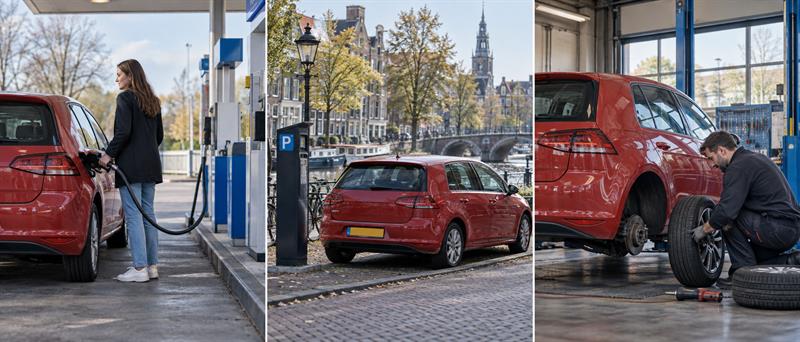
The asking price tells you whether you can buy the car. It does not tell you whether you can comfortably own it. A realistic Dutch car budget includes depreciation, MRB, insurance, energy, maintenance, tyres, parking, and a reserve for repairs.
Use One Monthly Number
Convert every cost to a monthly amount, including bills paid quarterly or annually. This makes very different cars easier to compare and exposes models that are inexpensive to buy but costly to keep.
Your True Monthly Cost
Depreciation + MRB + insurance + fuel or charging + maintenance and repairs + tyres + APK + parking + finance cost + other fixed services
1. Depreciation: The Quiet Cost
Depreciation is the difference between what you pay and what the car is likely to be worth when you sell it. It does not arrive as an invoice, but it is often one of the largest ownership costs.
Estimate it with:
(Purchase price − expected resale value) ÷ months owned
For example, a car bought for €15,000 and sold three years later for an estimated €9,000 loses €6,000 over 36 months: about €167 per month. Use comparable Dutch listings conservatively and remember that dealer asking prices are usually higher than trade-in offers.
2. Motor Vehicle Tax (MRB)
MRB, commonly called wegenbelasting, depends on factors including vehicle type, fuel, weight, and province. Two cars with the same purchase price can therefore have very different tax bills. Use the official Tax and Customs Administration calculator with the registration number or the correct vehicle data, then divide a quarterly result by three.
Rates and discounts change, especially for electric and low-emission vehicles. Use the current calculator rather than an old table from a forum or advertisement. See our guide to Dutch car taxes for the difference between MRB and BPM.
3. Insurance
Request actual quotes for the exact registration number and drivers. Premiums depend on coverage, postcode, age, annual distance, vehicle, excess, and claim-free years. An expat's foreign no-claims history may not be valued identically by every insurer.
Compare coverage as well as price. A cheap WA policy and a broader All Risk policy do not represent the same risk to your budget. Our WA, WA+, and All Risk guide explains the difference.
4. Fuel or Charging
Estimate your own driving rather than relying on the official laboratory consumption figure:
Monthly kilometres ÷ real-world kilometres per litre × price per litre
For an EV, use monthly kilometres, realistic kWh per 100 km, charging losses, and the price mix for home, public, and rapid charging. Cheap home charging and frequent motorway rapid charging can produce very different results for the same car.
5. Maintenance, Repairs, APK, and Tyres
A maintenance budget should reflect the car's age, mileage, service schedule, technology, and current condition. Review invoices and identify major jobs likely during your ownership: timing belt, transmission service, brakes, tyres, air conditioning, suspension, hybrid components, or a 12-volt battery.
Add separate reserves for:
- Scheduled servicing and fluids.
- APK inspections and any resulting repairs.
- Wear items such as tyres, brakes, wipers, and bulbs.
- Unexpected mechanical or electrical faults.
A car with four nearly worn premium-size tyres can be more expensive on day one than another example with a slightly higher asking price. A pre-purchase inspection lets you replace a guess with a condition-based forecast.
6. Parking and Local Charges
For many city residents, parking changes the entire calculation. Check whether your address qualifies for a resident permit, its price, the waiting list, whether a second vehicle is allowed, and what you will pay while waiting. Add workplace parking, visitor costs, garages, tolls, ferries, and environmental-zone restrictions relevant to your routes.
7. Finance Without Double Counting
If you borrow, cash flow and economic cost are not identical. Your full loan payment matters to monthly affordability, but part of it repays the amount borrowed and leaves you owning an asset. When comparing total ownership cost, add interest and fees to depreciation rather than adding both depreciation and the entire loan repayment. For a household cash-flow budget, include the actual loan payment.
8. Smaller Costs That Add Up
- Roadside assistance and replacement transport.
- Car washing, seasonal wheels, and tyre storage.
- Charging card subscriptions or connected-car services.
- Accessories such as a child seat, roof rack, or charging cable.
- A one-time independent inspection and registration-transfer fee.
Compare Powertrains Around Your Actual Use
| Type | Often suits | Budget checks |
|---|---|---|
| Petrol | Lower or mixed annual mileage | Real consumption, timing system, expected maintenance |
| Diesel | Frequent longer journeys | Higher MRB, emissions equipment, city access, resale |
| Hybrid | Urban and mixed driving | Battery condition, petrol consumption, two power systems |
| Electric | Predictable use with convenient charging | Battery health, charging mix, range, tax changes, insurance |
A Five-Car Shortlist Method
- Choose five realistic cars, not just five models.
- Record the registration number, asking price, mileage, tyres, APK date, and service needs.
- Get an MRB result and insurance quote for each.
- Estimate energy from your monthly kilometres and real-world consumption.
- Estimate depreciation and immediate maintenance.
- Add parking and finance costs.
- Compare the monthly total and keep an emergency buffer outside it.
The cheapest advertisement is rarely the cheapest car. The best value is usually the vehicle with a sensible purchase price, documented history, manageable fixed costs, and no major neglected work waiting immediately after delivery.
Useful Calculators and Checks
- Tax Administration: calculate MRB (Dutch)
- RDW: check vehicle specifications and APK date (Dutch)
- Dutch environmental-zone checker
Rates, fuel prices, and local charges change. Calculate with current information for the exact vehicle and your home address.
Compare Condition as Well as Monthly Cost
DealerCenter can assess the real car behind the spreadsheet, identify upcoming work, and help negotiate from evidence. Book a free consultation today.


