
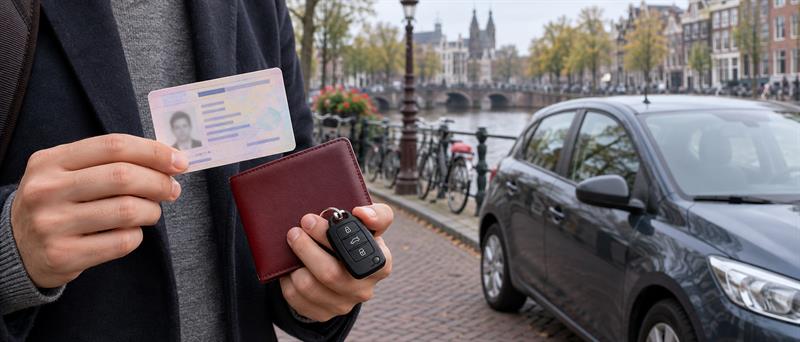
Buying and registering a car does not automatically mean your foreign driving licence remains valid. The answer depends on where the licence was issued, when it was issued, when you became resident in the Netherlands, and whether you qualify to exchange it.
EU and EFTA Licences
If your licence was issued by an EU or EFTA country before you moved to the Netherlands, ordinary passenger-car categories such as B can generally be used for up to 15 years from the original issue date, provided the licence remains valid. Heavy categories such as C and D generally have a five-year period from issue.
If that 15-year or five-year period had already passed while the foreign licence was still valid, the RDW may allow use for another two years after relocation. A licence issued by another EU/EFTA country while you were already living in the Netherlands is treated differently and normally must be exchanged before it can be used here.
Licences from Outside the EU/EFTA
A valid licence issued outside the EU/EFTA can generally be used during the first 185 days after you relocate to the Netherlands. After that, you need a Dutch licence to continue driving. Applying for an exchange does not extend the 185-day period.
If the categories on your licence do not use the familiar A, B, C, D, and E designations, the RDW advises obtaining an international driving permit in the country that issued your licence. That permit is a translation aid; it does not replace the original licence or extend how long a resident may drive.
Count from Your Relocation Date
For many non-EU/EFTA drivers, the critical deadline is 185 days after moving to the Netherlands, not 185 days after buying a car. Start the exchange process early because municipality, health-declaration, and RDW processing can take time.
Can Your Licence Be Exchanged?
A valid EU/EFTA licence can generally be exchanged. For licences from outside the EU/EFTA, exchange is normally possible only for designated countries and categories, or under a qualifying Dutch expat tax scheme. Other conditions apply, including Dutch BRP registration and, in many cases, proof that you lived in the issuing country for at least 185 days in the year the licence was obtained.
You apply through the municipality where you are registered. Depending on the licence and your circumstances, you may need:
- Your foreign driving licence and valid identity document.
- A compliant colour passport photograph.
- A certified translation when the document uses unfamiliar characters.
- A CBR health declaration.
- Evidence of the applicable expat tax decision if relying on that route.
If exchange is not available, you will normally need to pass the Dutch CBR theory and practical tests. Do not wait until the 185-day period is almost over to investigate.
Driving While an Exchange Is Being Processed
You must still be legally entitled to drive and be able to present a driving licence when required. An exchange application does not revive an expired Dutch-use period. Because your foreign licence is normally submitted with the application, driving during processing can create practical enforcement and insurance complications. Confirm your situation with the municipality, RDW, and insurer rather than assuming an application receipt is enough.
Buying a Car Versus Driving It
Licence validity and vehicle ownership are separate questions. You may be able to purchase and register a car while still needing to resolve your right to drive it. You also need an insurer willing to cover you on the basis of your current licence and driving history.
From 2026, a registration transfer performed at a standard registration counter or RDW-approved vehicle company requires a valid Dutch driving licence as identification. If you do not have one, eligible buyers can transfer online with DigiD and identity verification, or use an RDW service desk or inspection station with an accepted identity document. Plan this before collection day.
Insurance and Foreign No-Claims History
Tell the insurer which country issued your licence, when you became resident, and who will be the main driver. Ask for written confirmation that the licence is accepted. Some insurers recognise a foreign no-claims statement, but document requirements and discounts differ. Request a dated English or Dutch statement from your previous insurer showing the policyholder, covered period, and claims history.
A Practical Expat Checklist
- Find your Dutch relocation or BRP registration date.
- Check the issuing country, issue date, expiry date, and licence categories.
- Use the RDW rules to calculate how long you may drive.
- Check exchange eligibility and start early if an exchange is required.
- Confirm acceptance with your proposed insurer.
- Choose the correct vehicle-registration transfer route for your ID.
- Do not test-drive or collect the car unless you are currently licensed and insured to do so.
Official Information
- RDW: driving with a foreign driving licence
- RDW: exchanging a foreign driving licence
- RDW: registering a purchased vehicle in your name
Driving-licence rules depend on individual dates and documents. Verify your exact position with the RDW or your municipality before driving.
Ready to Buy Once Your Documents Are in Order?
DealerCenter helps international buyers find, inspect, and negotiate the right used car in the Netherlands. Book a free consultation today.


