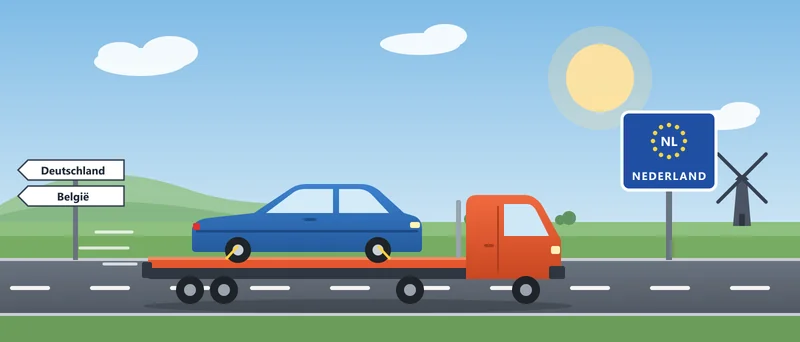
Used cars in Germany and Belgium are often cheaper than in the Netherlands. You can buy one there and bring it here. But a lower price abroad does not always mean a cheaper car. You must pay a Dutch car tax, get the car checked and get Dutch number plates. This guide explains every step in simple words, so you know what to do and what it will cost.
The Short Version
- Find a car and check it before you pay.
- Work out the Dutch car tax (BPM) before you buy.
- Bring the car to the Netherlands on a truck or with temporary export plates.
- Take the car to an RDW inspection station.
- Declare and pay the BPM.
- Get your Dutch registration, number plates and insurance.
The rest of this article explains each step.
Words You Will See in This Guide
Importing a car comes with many new words. Here they are, explained simply. You can come back to this list at any time.
| Word | What it means |
|---|---|
| Import | Bringing a car from another country and registering it here, so it can drive on Dutch roads. |
| RDW | The Dutch government office for vehicles. It checks cars and keeps the list of every car in the Netherlands. |
| Kenteken | The Dutch word for a car's registration number, the letters and numbers on the number plate. |
| Registration certificate | The official paper (or card) that shows a car is registered and who it belongs to. In Germany, it comes in two parts: Zulassungsbescheinigung Teil I and Teil II. You need both. |
| BPM | A Dutch tax you pay once, when a car gets Dutch registration for the first time. The more CO₂ the car makes, the higher the tax. |
| CO₂ value | How much carbon dioxide (an exhaust gas) the car puts out, in grams per kilometre (g/km). It is the main number used to work out BPM. |
| CoC | Certificate of Conformity. A paper from the car maker that lists the car's official technical details, including its CO₂ value. |
| Belastingdienst | The Dutch tax office. You declare and pay BPM to them. |
| BRP | The Dutch list of people who live in the Netherlands. You are added when you register at your town hall. |
| DigiD | Your personal login for Dutch government websites. You need it to book the RDW appointment and file the BPM online. |
| APK | The Dutch regular safety test for cars. Germany has the same idea, called HU (often done by TÜV or DEKRA). The English term is PTI, periodic technical inspection. |
| WA insurance | The basic car insurance every car on Dutch roads must have. It pays for damage you cause to other people. |
| MRB | The Dutch road tax you pay every month or every three months while you own a car. Also called wegenbelasting. |
| VAT (btw) | A sales tax added to the price of many things. For cars from other EU countries, you only pay Dutch VAT if the car is (almost) new. |
Can You Import a Car Yourself?
Yes, if all of these are true:
- You are 18 or older.
- You are registered in the BRP, which means you live in the Netherlands and registered at your town hall.
- You have a DigiD to book the RDW appointment online.
- You can go to the RDW inspection yourself. The RDW says nobody else can do it for you, except an RDW-approved company.
This guide is about cars from Germany and Belgium. Both are in the European Union (EU), so you do not pay import duties at the border. Cars from outside the EU follow different and more expensive rules.
Is Importing Really Cheaper? Do the Maths First
Many people compare only two prices: the German price and the Dutch price. That is a mistake. A car you import costs this:
Price abroad + transport + RDW fees + BPM + number plates = your real price
Only then can you compare it with the same car for sale in the Netherlands. A Dutch car already has its BPM paid, so its price already includes that tax.
An Example
Here is a made-up example to show how the sum works. Your numbers will be different.
| Cost | Example amount |
|---|---|
| Car price in Germany | €18,000 |
| Transport to the Netherlands on a truck | €400 (example; ask for quotes) |
| RDW fees (see the fee table below) | €144.10 |
| BPM (worked out further down) | €1,420 |
| Dutch number plates | €50 (example) |
| Real price | About €20,014 |
If the same car costs €21,500 in the Netherlands, importing saves about €1,500. That is still a good saving. But remember what you give up: you will spend time travelling and doing paperwork, and a foreign seller is harder to reach if something goes wrong. If the Dutch car costs €20,000, importing saves you nothing.
Use our free Import Tax Calculator to estimate the BPM for the car you are looking at.
Step 1: Check the Car Before You Pay
This is the most important step. Once you have paid and the car is in the Netherlands, it is very hard to get your money back from a seller in another country.
Check the papers
- Registration certificate: make sure you get the full, original document. For a German car, that is both Teil I and Teil II. The RDW keeps the original when you import the car.
- VIN: the VIN (vehicle identification number) is the car's unique 17-character ID. The RDW tells buyers to check that the VIN on the paper matches the VIN stamped on the car. If they are different, do not buy the car.
- CoC: ask for the Certificate of Conformity. It is not required, but it shows the official CO₂ value. Without it, working out the BPM is harder and can cost you more.
- Service history: ask for the service book and repair bills. They help show the car was looked after and that the mileage is real.
- Sales contract or receipt: the RDW advises always getting one, even if it is handwritten and signed. Write down the mileage, the date the car was first registered, and whether it has had an accident.
Check the mileage
Mileage fraud means someone turns back the odometer, the meter that shows how many kilometres a car has driven, so the car looks less used and sells for more. It is a known problem with imported cars.
- Belgium: ask for the Car-Pass. This is a document from a non-profit organisation that the Belgian government made responsible for fighting mileage fraud. It lists the car's past mileage readings.
- Germany: compare the odometer with the mileage written on old HU (safety test) reports, service records and repair bills. The numbers should go up over time, never down.
- Watch out for: a price much lower than similar cars, or wear that does not match the low mileage, such as a shiny worn steering wheel on a car that has "only" driven 40,000 km.
Good news: since 3 February 2026, the RDW adds German mileage readings to the Dutch register when a German car is imported. Belgian readings have been added since January 2025. If the numbers do not go up as they should, the car's record is marked "Onlogisch" (illogical). Note that this check happens after you import the car, so do your own checks before you pay.
Check the car itself
Photos can hide a lot. The RDW warns buyers never to trust how a car looks and to look underneath it too. If you cannot judge a car's condition yourself, get an independent inspection before you pay. A wasted trip costs less than a bad car.
Is the Car Almost New? You May Owe VAT
For VAT, the Belastingdienst treats a car as "new" if it has driven less than 6,000 km or was first used no more than 6 months ago. Only one of these has to be true. If the car counts as new, you must pay 21% Dutch VAT on it, even as a private buyer, using a special tax form. For example, a car with 7,000 km that was first used 5 months ago still counts as new. Most used cars are older than this, so this rule usually does not apply.
Step 2: Work Out the BPM Before You Buy
BPM is often the biggest surprise. Here is how it works, step by step.
1. Find the "gross BPM"
The gross BPM is the tax the car would pay if it were new. It depends mainly on the car's CO₂ value: more CO₂ means more tax. Diesel cars pay an extra diesel charge on top. A fully electric car pays the lowest amount. In 2026, that is €687 for a new electric car.
For a used car, the Belastingdienst lets you choose between today's tax rates and the older rates from around the time the car was first registered. You may pick the one that gives you the lower amount.
2. Take off the discount for age
A used car has lost value, so you do not pay the full gross BPM. You get a discount, called depreciation (afschrijving). There are three ways to work it out, and you may choose the one that gives you the lowest BPM:
- Fixed table (forfaitaire tabel): a table from the Belastingdienst. The older the car, the bigger the discount. This is the simplest way, and the only one you can file online.
- Price list (koerslijst): a Dutch car trade price list that shows what the car was worth new and what it is worth now. You must file it on paper.
- Valuation report (taxatierapport): a report from an independent, certified valuer. You can only use it if the car has more wear or damage than normal, or is not on a price list. The valuer must inspect the car within one month before the RDW inspection. You must also file this on paper.
3. A worked example with the fixed table
The fixed table counts the time from the car's first registration anywhere to the day the RDW approves it. Here are a few rows from the table:
| Age of the car | Discount on gross BPM |
|---|---|
| 1 year 6 months to 2 years 6 months | 42%, plus 0.75% for each extra month |
| 2 years 6 months to 3 years 6 months | 51%, plus 0.5% for each extra month |
| 3 years 6 months to 4 years 6 months | 57%, plus 0.42% for each extra month |
| 4 years 6 months to 5 years 6 months | 62%, plus 0.42% for each extra month |
| 9 years 6 months and older | 81%, plus 0.19% for each extra month |
Imagine a petrol car that is exactly 5 years old on the day the RDW approves it, with a gross BPM of €4,000:
- 5 years is in the "4 years 6 months to 5 years 6 months" row. That row starts at 62%.
- The car is 6 months past the start of that row: 6 × 0.42% = 2.52%.
- Total discount: 62% + 2.52% = 64.52%.
- You pay the rest: 100% − 64.52% = 35.48% of €4,000 = about €1,420.
The table also counts part of a month as a full month, so check the exact dates. The full table is on the Belastingdienst website (link at the end). Our Import Tax Calculator does this sum for you.
Step 3: Bring the Car to the Netherlands
A German or Belgian car loses its normal number plates when you buy it, because those plates stay with the seller. So you need another way to get the car here. You have three main options.
Option A: Put the car on a truck
A transport company carries the car on a truck or trailer. The car does not need number plates or insurance for this. It is often the simplest and safest choice. The German motoring club ADAC also names this as the fallback when export plates are not possible.
Option B: German export plates (Ausfuhrkennzeichen)
Germany has special plates for cars leaving the country. They have a red stripe with the end date on it, and you buy insurance for them at the same time, usually from the plate maker near the registration office. According to the ADAC:
- The car needs a valid German safety test (HU).
- The plates are valid for at least one month and at most twelve months.
- When the date passes, the plates and the insurance both stop working.
Do not use German short-term plates (Kurzzeitkennzeichen, with a yellow stripe). They are meant for short trips inside Germany. The ADAC reports problems using them in the Benelux countries, and the ANWB, the Dutch motoring club, says you may not drive on them in the Netherlands.
Option C: Belgian transit plates (X plates)
Belgium has special "X" export plates for cars leaving the country. They are for people who do not live in Belgium, so they fit someone who lives in the Netherlands. According to the Belgian government:
- They are valid for 30 days.
- You apply at the "TRANSIT" counter of the DIV (the Belgian vehicle registration office) in Brussels.
- You must bring original documents, including proof of insurance, the sales contract and the car's registration papers. Copies are not accepted.
The RDW does not give out plates for driving a car from abroad to the Netherlands. So you must arrange this in the seller's country, or use a truck.
Step 4: Book the RDW Inspection
Once the car is in the Netherlands, book an appointment at an RDW inspection station. Do it online with your DigiD and pay the fees online. Here is what to bring:
- The complete original foreign registration certificate. The RDW keeps it, so make a copy first. You need the copy for your BPM declaration.
- Your ID: passport, ID card or driving licence.
- The CoC, if you have it.
- Proof of a valid foreign safety test (the German HU report, or the sticker on the plate), if you want the RDW to accept it so you do not need a Dutch APK right away.
How do you get the car to the station?
If the car came on a truck and has no plates, ask for a free one-day plate number (eendagskenteken) when you book the appointment. It lets you drive the car to the RDW. After the visit, you may not drive the car on public roads until you receive your Dutch registration certificate.
If you drive to the station on foreign export plates, the RDW collects the foreign registration certificate.
Step 5: The Inspection
Arrive at the time in your confirmation email. The inspection takes about 25 to 55 minutes. The RDW will:
- check that the car is really the car on the papers (this is called identification);
- check your documents;
- add the car's details to the Dutch register if everything is in order.
The RDW does not do a full safety test. That is what the APK is for.
If the car has damage: repair it before the inspection and choose the "post-repair" option when you book. If the RDW finds damage during the inspection, the car gets a driving ban. You may then only drive the shortest route home until it passes a new inspection.
Step 6: Declare and Pay the BPM
- You file the BPM declaration after the RDW inspection.
- The Belastingdienst needs the inspection data from the RDW first. This can take up to 5 working days. If the website says it cannot find your car's VIN, try again later.
- You can file online with DigiD if you are a private person and use the fixed table. If you use a price list or a valuation report, you must file on paper.
- Have the car's VIN ready, plus its Dutch catalogue price (the official new price, with options) on the date it was first registered.
- If you owe BPM, the registration is only finished once the Belastingdienst has received your payment.
Step 7: Registration, Plates, Insurance and APK
When both the RDW and the Belastingdienst have approved everything, the last steps come quickly. Do them in this order:
- Registration certificate: you receive your new Dutch registration card by post within 5 working days. About two working days later, a letter arrives with the full registration code. You need this code if you ever sell the car, so keep it safe.
- Number plates: take your registration card to an RDW-approved plate maker. Many garages and car parts shops can make them.
- Insurance: the car must have at least WA insurance from the moment it is registered in your name. The insurer will ask for a reporting code: the last 4 characters of the VIN, which are also on your registration card.
- APK: if the car has no valid foreign safety test, book an APK at a garage right after you get the registration card. The RDW warns that you will be fined if you do it later.
- Road tax (MRB): you do not need to do anything. The Belastingdienst sends you the bill automatically.
What Does the RDW Charge?
These are the fees for a private person importing a car from an EU country, as listed on the RDW website. You pay them online when you book.
| What you pay for | Fee |
|---|---|
| Identification of a car (up to 3,500 kg) | €58.50 |
| Registration certificate | €50.00 |
| Registering the car in your name | €13.10 |
| Recycling fee (pays for recycling the car at the end of its life) | €22.50 |
| Total | €144.10 |
Fees can change. Check the RDW website before you book.
The Most Common Mistakes
- Buying before working out the BPM. A car that looks cheap can end up costing more than a Dutch one.
- Forgetting the second half of the papers. A German car needs both Teil I and Teil II.
- Not making a copy of the foreign registration certificate before the RDW keeps it.
- Trusting the odometer. Check the mileage with documents before you pay.
- Driving on German short-term plates in the Netherlands.
- Driving after the RDW visit on a one-day plate. Wait until your Dutch registration arrives.
- Leaving the APK too late when the car has no valid foreign safety test.
Your Import Checklist
- Compare the real price (price + transport + RDW fees + BPM + plates) with Dutch cars.
- Check the VIN, full registration papers, CoC, service history and mileage.
- Check whether the car counts as "new" for VAT.
- Get a signed sales contract.
- Bring the car to the Netherlands on a truck or on proper export plates.
- Book the RDW inspection with DigiD, and copy the foreign papers.
- File and pay the BPM.
- Get plates and WA insurance, and book an APK if needed.
Once your car is on Dutch plates, learn what it costs to own each month in our monthly cost guide, and read more about Dutch car taxes in BPM, MRB and Wegenbelasting.
Want Help With Your Import?
Our Import & Registration service handles the hard parts for you: transport, the documents you need, the BPM estimate, the RDW inspection and the registration. You get one point of contact from start to finish. Ask for an import quote.
Further Reading
- RDW: importing a vehicle from an EU or EFTA country
- RDW: tips when importing a vehicle
- RDW: German mileage readings added to the Dutch register (Dutch)
- Belastingdienst: calculating BPM for a passenger car (Dutch)
- Belastingdienst: the fixed table, price list and valuation report (Dutch)
- Belastingdienst: filing a BPM declaration (Dutch)
- Belastingdienst: VAT on new and almost-new vehicles from EU countries (Dutch)
- ADAC: German export plates (German)
- Belgian Federal Public Service Mobility: export transit plates
- Car-Pass: Belgian mileage history
Rules, fees and tax rates can change. This article reflects the rules published by the RDW, the Belastingdienst and other official sources in November 2026. It is general information, not personal tax advice. Check the official sources for your exact car before you buy.


