A used electric car can be a smart buy. It is cheaper than a new one, and it costs little to run if you can charge it at home or at work. But an electric car has one part that matters more than anything else: the battery. This guide shows you, step by step, how to check the battery and the other things that are different on an electric car, in simple words.
The Short Version
- Get an independent battery health report.
- Check how much battery warranty is left.
- Ask how the car was charged.
- Test the charging yourself, and check the cable.
- Work out the real range for your daily trips.
- Check the parts that wear differently on an electric car: tyres, brakes and the small 12-volt battery.
- Do all the normal used-car checks too.
Words You Will See in This Guide
| Word | What it means |
|---|---|
| EV | Electric vehicle. A car that runs only on a battery and has no petrol or diesel engine. |
| Battery | In this guide, the big battery under the floor that drives the car. It is the most expensive part of an EV. |
| kWh | Kilowatt-hour. A unit for how much energy a battery can hold, like litres for a fuel tank. A 60 kWh battery holds more than a 40 kWh battery. |
| Capacity | How much energy the battery can hold right now. |
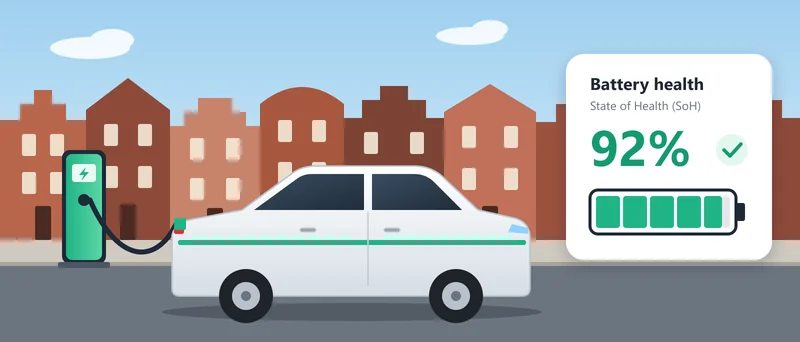
| SoH | State of Health. How much capacity the battery has left compared with when it was new, shown as a percentage. 100% is like new. 90% means it holds 90% of what it held new, so the car goes about 10% less far. |
| Range | How far the car can drive on a full battery. |
| AC charging | Slower charging, at home, at work or at a normal public charging pole. |
| DC fast charging | Very quick charging at special fast-charging stations, often along motorways. |
| Type 2 and CCS | The shapes of the plugs. Type 2 is the normal plug for AC charging in Europe. CCS is the plug used at most fast chargers. An older plug for fast charging is called CHAdeMO; it is much less common at new fast-charging stations. |
| 1-phase and 3-phase | Two kinds of electricity connection. A car that can use 3-phase power charges much faster at an AC charging pole. |
| Onboard charger | The part inside the car that takes power from an AC charging pole and puts it in the battery. Its power, in kW (kilowatts), decides how fast AC charging is. |
| Regenerative braking | When you slow down, the electric motor works backwards, makes electricity and puts it back into the battery. Because of this, the normal brakes are used less. |
| 12-volt battery | A second, small battery, like the one in a petrol car. It powers things like the lights, locks and screens, and it "wakes up" the car. |
| Heat pump | An efficient heater that warms the inside of the car using less battery energy. It helps the car lose less range in winter. |
Why the Battery Matters So Much
Every battery slowly loses some capacity as it gets older and is used. Think of a phone: after a few years, it does not last as long on one charge. A car battery works the same way, only much more slowly.
- Milieu Centraal, the Dutch public information centre for sustainability, says a battery loses about 2% of its capacity per year with normal use.
- The ANWB, the Dutch motoring club, says a five-year-old EV usually still has about 92% to 95% of its original capacity.
So most batteries age well. But not every car is average. Two cars of the same model with the same mileage can have different batteries, depending on how they were charged and used. That is why you check this car's battery, not just its age and mileage.
Step 1: Get a Battery Health Report
A battery health report tells you the battery's SoH. There are two kinds:
- A reading from the brand's dealer. The dealer can read the SoH from the car's computer. The ANWB points out that this number is calculated by the car maker, and the maker wants it to look good. So it is not independent.
- An independent battery test. A company with no interest in the sale tests the battery. In the Netherlands, DEKRA offers a test that takes about 15 minutes, with a discount for ANWB members. In Germany, the ADAC offers a test with a company called Aviloo. You get a written report.
Ask the seller for a recent independent report. If there is none, ask if you can have the battery tested before you buy. A seller who says no is a warning sign.
What is a good SoH?
There is no official pass or fail number. The ANWB gives this rule of thumb:
| SoH | What it means |
|---|---|
| 95% or more | Excellent |
| 90% to 95% | Very good for a used car |
| 85% to 90% | Normal for many older EVs |
| 80% to 85% | Still usable, but the price should be lower |
| Below 80% | Look very carefully at the range and the price |
The German ADAC looks at mileage too. Its experts think these are the lowest acceptable values:
| Mileage | SoH should be at least |
|---|---|
| 50,000 km | 92% |
| 100,000 km | 88% |
| 150,000 km | 84% |
| 200,000 km | 80% |
Example: a car with 100,000 km and an SoH of 91% is better than average. A car with 50,000 km and an SoH of 85% has lost more than it should, so ask why, and pay less.
Step 2: Check the Battery Warranty
A warranty is the car maker's promise to repair or replace a part if it fails within a set time. Most EV batteries have their own warranty, separate from the rest of the car.
- Most makers now give 8 years or 160,000 km, whichever comes first. The years usually count from when the car was new, not from the day you buy it. So a 5-year-old car may have only about 3 years left.
- The warranty usually pays out only if the capacity drops below a set level, usually 70%.
- Some older, first-generation EVs had a shorter warranty, often 5 years or 100,000 km.
- The rules are different for each brand. Check them for the exact car.
The ADAC warns that a warranty claim is harder without a complete service history. Ask for the service book and the bills, and check that the car was serviced as the maker required.
Step 3: Ask How the Car Was Charged
How a battery was treated affects its health. Milieu Centraal names three habits that wear a battery faster:
- Lots of fast charging. Fast charging puts more stress on the battery than normal charging. Some sellers can show how many fast-charging sessions the car has had.
- Often standing at 100% full for a long time. Standing at about half full is kinder to the battery.
- Lots of heat or cold, such as parking in full sun all summer.
Good questions to ask: "Where did you usually charge? How often did you fast charge? Did you usually charge to 80% or to 100%?" Milieu Centraal also notes that many used EVs are former lease cars, which are often well maintained.
Step 4: Test the Charging Yourself
A car that does not charge properly is a big problem. Test it before you buy.
- Look at the charging port, where the plug goes in. Check for damage, dirt, burn marks and broken covers.
- Plug it into an AC charging pole and check that charging starts and the car shows it.
- Try a fast charger if you can, to see that DC charging works too.
- Check the charging cable. Does the car come with a Type 2 cable? Is it in good condition? The ADAC advises writing down in the sales contract which cables come with the car.
- Check 1-phase or 3-phase. The ANWB says you cannot add 3-phase charging later. For a large 80 kWh battery, 3-phase charging takes about 8 hours, but 1-phase can take about 20 hours.
- Check the plug for fast charging. CCS is the standard. A car with only CHAdeMO will find fewer new fast chargers.
If you can charge at home or at work most of the time, fast charging matters less.
Step 5: Work Out the Real Range
The range in the advert is usually more than you will get in real life. The range drops on the motorway, in cold weather, and when you use the heater. A car with a heat pump loses less range in winter.
Here is an easy way to estimate the range. The ADAC uses this example:
Battery size ÷ energy use = range
A 40 kWh battery that uses 20 kWh per 100 km on the motorway: 40 ÷ 20 = 2, so about 200 km. Now take the SoH into account. If the SoH is 90%, the battery holds about 36 kWh, so the range is about 180 km.
Now compare that with your life. The ANWB says the average commuter drives about 40 km a day. Most used EVs do that easily. The ADAC says a 50 km daily commute is fine even with an older battery, but 100 km or more can be tight with an older, first-generation battery. Leave room for winter.
For a simple test drive check, Milieu Centraal suggests charging the car fully, driving it, and comparing the distance with the original range. At the very least, look at the range the car shows when the battery is full.
Step 6: Check the Parts That Wear Differently
An electric car has fewer parts that wear out than a petrol car: no oil changes and no exhaust. But some parts wear in their own way.
- Tyres: EVs are heavy and powerful, so the ANWB says their tyres wear faster. Check how deep the tread is, and look for uneven wear. New tyres for an EV can be expensive.
- Brakes: thanks to regenerative braking, the brakes wear less. But the ANWB warns that brakes that are not used much can rust. On the test drive, brake firmly in a safe place. Listen for grinding and feel for shaking, and look at the brake discs (the metal discs behind the wheels) for heavy rust.
- The 12-volt battery: if it is weak, the car may not start, even with a full big battery. The ANWB advises checking it, especially in winter. Watch for warning messages on the dashboard.
- Under the car: the big battery sits under the floor. Look for scrapes, dents or damage underneath. Ask the seller whether the battery was ever damaged or repaired, and have the answer written in the contract, as the ADAC advises.
Step 7: Do the Normal Used-Car Checks Too
An EV is still a used car. The ADAC reminds buyers that all the usual checks apply: a test drive, signs of accident damage, rust and a full history. Use these guides:
- How to read an RDW vehicle report: mileage, APK and open recalls (a recall is when the maker calls cars back to fix a known problem).
- How to spot hidden defects on a viewing.
- Our free Car Viewing Kit, with questions for the seller and a test-drive checklist.
When to Walk Away
- The seller will not let you test the battery.
- The SoH is much lower than the ADAC table above, and the price does not reflect it.
- The car will not charge, or the charging port is damaged.
- There are warning lights about the battery or the electric system.
- There is damage under the car where the battery sits.
- There is no service history and the battery warranty matters to you.
Money Matters
- No subsidy: the Dutch government subsidy for buying a used EV (called SEPP) is permanently closed. The last private applications were possible until 27 December 2024. Ignore old websites that still mention €2,000.
- Road tax: in 2026, a fully electric car pays 70% of the road tax (MRB) of a similar petrol car. EVs are heavy, and heavier cars pay more, so check the exact amount. Read more in our guide to Dutch car taxes.
- Bigger is not always better: the ANWB notes that a bigger battery means a heavier car, more road tax and often higher insurance. If you can charge at home or at work, a smaller battery is the cheaper choice.
- A home charger: Milieu Centraal says a home charging point costs about €1,300 to €2,200, including installation.
- Value: used EVs lose value faster than many petrol cars. That is good for you as a buyer, because you pay less. But expect the car to be worth less when you sell it.
For the full picture, see what a used car really costs per month, and if you are still choosing, read Electric, Petrol or Hybrid.
Questions to Ask the Seller
- Do you have a recent independent battery health report? If not, may I have the battery tested?
- How much battery warranty is left, in years and kilometres?
- Can I see the service book and the bills?
- Where and how did you usually charge? How often did you fast charge?
- Has the battery ever been damaged, repaired or replaced?
- Which charging cables come with the car?
- Does it charge on 3-phase? Does it have a heat pump?
- Was it a lease car or a company car before?
Buying from a dealer gives you more legal protection than buying from a private seller. Read Dealer or Private Seller? to understand your rights.
Not Sure About the Battery? Let Us Check
We inspect used electric cars for expats in the Netherlands. We check the battery report, the charging, the tyres, the brakes, the underbody and the history, then tell you in plain words whether the car and the price make sense. See our inspection packages or send us the listing.
Further Reading
- ANWB: why you should always get an EV battery check (Dutch)
- ANWB: buying a used electric car (Dutch)
- ANWB: what maintenance an electric car needs (Dutch)
- Milieu Centraal: buying a used electric car (Dutch)
- ADAC: buying a used electric car (German)
- RVO: the SEPP electric car subsidy (closed) (Dutch)
This article reflects information from the ANWB, Milieu Centraal, the ADAC and the Dutch government available in November 2026. Battery warranties, taxes and test offers can change. Check the details for the exact car before you buy.


