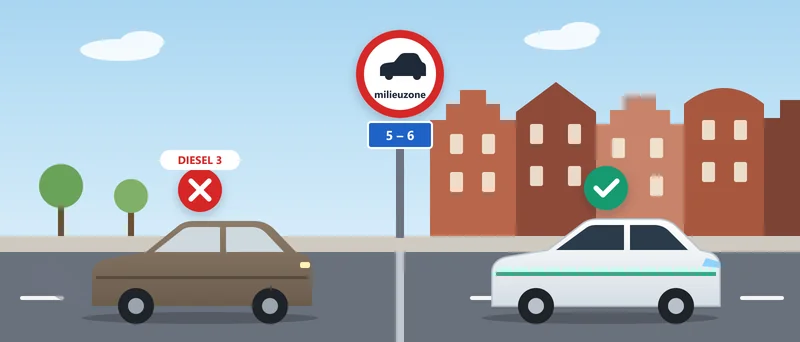
Some Dutch city centres do not allow older diesel cars to enter. If you drive in anyway, a camera reads your number plate and you get a fine. This matters most when you are buying a car: a cheap old diesel can turn out to be a car you cannot drive to your own home or office. This guide explains the zones in simple words, shows which cities have them, and tells you how to check any car in one minute.
The Short Version
- Petrol, LPG, petrol-hybrid and electric cars may enter all Dutch environmental zones. The rules are about diesel.
- Old diesel cars are banned from the centres of Amsterdam, Utrecht, Arnhem and The Hague. Eindhoven follows on 1 January 2027.
- Whether a diesel may enter depends on its emission class, a number from 0 to 6. Most zones need class 5 or higher.
- Vans have stricter rules in zero-emission zones in many cities.
- The fine is €130 for a car, plus costs.
- Check any Dutch car for free on milieuzones.nl before you buy it.
Words You Will See in This Guide
| Word | What it means |
|---|---|
| Environmental zone (milieuzone) | An area, usually a city centre, where older, more polluting vehicles may not drive. Also called a low-emission zone. |
| Zero-emission zone (zero-emissiezone, ZE zone) | An area where, over time, only vans and trucks with no exhaust gases at all (such as electric ones) may drive. It is meant for deliveries. |
| Emission class (emissieklasse) | A number from 0 to 6 that shows how clean a vehicle's exhaust is. The higher the number, the cleaner. It follows the European "Euro" standard: a Euro 5 car is class 5. |
| Euro standard | European rules for how much pollution a new car may make. Newer cars meet stricter standards (Euro 4, Euro 5, Euro 6). |
| Diesel | A type of fuel. Older diesel engines put out more harmful soot and gases than petrol engines, which is why the zones target them. |
| First registration date | The day the car was first registered anywhere. If a car's Euro standard is unknown, this date decides its emission class. |
| Exemption (ontheffing) | Special permission to enter a zone with a car that normally may not. |
| Van (bestelauto) | A small commercial vehicle for carrying goods. It is registered differently from a normal passenger car. |
Why These Zones Exist
Exhaust gases from older diesel engines contain soot and other harmful substances. In busy city centres, many cars together make the air unhealthy to breathe. Cities use these zones to keep the oldest, dirtiest vehicles out. Newer cars must meet much stricter European rules, so they may still enter.
The Two Kinds of Zones for Cars
For passenger cars, there are two colours of zones. You can tell them apart by the small plate under the zone sign.
| Zone | Diesel cars that may enter | Diesel cars that may not |
|---|---|---|
| Green zone | Class 4, 5 and 6 | Class 0, 1, 2 and 3 |
| Blue zone | Class 5 and 6 | Class 0 to 4 |
Petrol, LPG and electric cars may enter both zones, whatever their age.
Which Cities Have a Zone for Diesel Cars?
| City | Zone | Diesel cars need |
|---|---|---|
| Amsterdam | Blue, inside the A10 ring road | Class 5 or higher |
| Utrecht | Blue, city centre | Class 5 or higher |
| Arnhem | Blue | Class 5 or higher |
| The Hague (Den Haag) | Green, city centre | Class 4 or higher |
| Eindhoven | Blue, inside the Ring, from 1 January 2027 | Class 5 or higher |
Some other cities have zones only for trucks, buses or mopeds, which do not affect normal cars. Rules change, so always check the city's own website or milieuzones.nl before you buy or travel.
How Old Is "Too Old"? A Rough Guide
If a diesel car's Euro standard is not known, its emission class follows the date it was first registered. This table from milieuzones.nl gives a rough idea:
| First registered | Emission class | Blue zone? |
|---|---|---|
| 2000 to 2004 | 3 | No |
| 1 January 2005 to 31 August 2009 | 4 | No (green zone: yes) |
| 1 September 2009 to 31 August 2014 | 5 | Yes |
| From 1 September 2014 | 6 | Yes |
Careful: this is a guide, not the final answer. Some cars met a newer Euro standard earlier than the table suggests, and some heavier vehicles follow other dates. A diesel from 2009, 2010 or 2011 is right at the edge, so always check the exact class.
How to Check Any Car in One Minute
- Get the registration number (kenteken) from the seller or the ad.
- Enter it in the Milieuzonecheck on milieuzones.nl. It shows which zones the car may enter.
- Or look up the emission class in the free RDW Kentekencheck on the RDW website. The RDW is the Dutch government office for vehicles.
Know the limits of the Milieuzonecheck:
- It works only for Dutch number plates.
- It does not show local exemptions.
- It says nothing about zero-emission zones for vans.
Driving a car on foreign plates? The rules still apply to you. Work out the class from the car's papers (look for "Euro 4", "Euro 5" or "Euro 6") or with the first-registration-date table on milieuzones.nl.
How Will You Know You Are Entering a Zone?
At every entrance, there is a round traffic sign with a red edge and the word "milieuzone". Below it is a small extra plate. Its colour (green or blue) and numbers show which diesel vehicles may enter. Learn to spot the sign.
Cities check with cameras that read number plates automatically and compare them with the RDW register. Sometimes officers check too.
The Fine
Since 26 November 2025, the fine for driving into a zone with a car that is not allowed is €130 for passenger cars, vans and buses, and €320 for trucks. Administration costs are added on top.
Vans: Zero-Emission Zones
Thinking of buying a van? Since 1 January 2025, several Dutch cities have zero-emission zones for vans and trucks. These are much stricter than the zones for cars. According to Op weg naar ZES, the official information site for these zones:
- Vans first registered from 1 January 2025 must be fully zero-emission (for example, electric) to enter.
- Vans with class 4 or lower may not enter.
- Vans with class 5 may enter until 1 January 2027.
- Vans with class 6 registered before 2025 may enter for a few more years. The end date is 1 January 2028, and the government has said it plans to move this to 1 January 2029.
- If you use a van only privately, not for a business, you may be able to get an exemption. You apply on the RDW website.
Normal passenger cars are not affected by zero-emission zones.
Exemptions: Who May Still Enter?
According to milieuzones.nl, some vehicles are free from the rules or can ask for an exemption:
- Classic cars that are 40 years or older.
- Diesel cars and vans adapted for a wheelchair.
- Vehicles adapted for a disability at a cost of €500 or more may get an exemption that is valid nationally.
- Some cities offer a day exemption for a single visit. For example, Arnhem charges €38.20 for one, and Eindhoven allows up to 12 per number plate per year. Check the city's website.
What This Means When You Buy a Car
- Think about where you live and work. If you live or work inside a zone, an old diesel is a bad buy, even if it is cheap.
- Think about where you will move. Expats often move between cities. A car that is fine in Rotterdam may not be welcome in Utrecht.
- Think about selling. Fewer people want an old diesel, so it may be harder to sell later.
- Think about road tax. Older diesel cars can also pay an extra soot charge (fijnstoftoeslag) on top of normal road tax. Read BPM, MRB and Wegenbelasting.
- Petrol, petrol-hybrid and electric cars are allowed everywhere. If you are still choosing, read Electric, Petrol or Hybrid.
Already own an old diesel in Utrecht?
Utrecht pays residents €500 or €1,000 to scrap a diesel car with class 4 or lower, with extra money for U-pass holders (a city pass for people with a low income). In October 2026, the city extended this scheme to the end of 2027. Check the Utrecht website for the conditions.
Your Checklist Before Buying a Diesel
- Get the registration number.
- Check the emission class on milieuzones.nl or the RDW website.
- Compare it with the zones where you live, work and often visit.
- Buying a van? Check the zero-emission zone rules too.
- Think about the road tax and how easy it will be to sell later.
Not Sure a Car Fits Your City?
When we check a car for you, we also check its emission class, its taxes and where you can drive it, so there are no surprises after you buy. See our packages or send us the listing.
Further Reading
- Milieuzones.nl: passenger cars and vans (Dutch)
- Milieuzones.nl: where the zones are (Dutch)
- Milieuzones.nl: emission class by first registration date
- Milieuzones.nl: enforcement and fines (Dutch)
- Milieuzones.nl: exemptions (Dutch)
- Op weg naar ZES: zero-emission zone rules for vans (Dutch)
- Eindhoven: the new zone for passenger cars (Dutch)
- Utrecht: scrappage subsidy for diesel cars extended to 2027 (Dutch)
Zone rules can change and cities decide their own boundaries and dates. This article reflects information from milieuzones.nl, Op weg naar ZES and the cities of Amsterdam, Utrecht, Arnhem, The Hague and Eindhoven available in November 2026. Always check the city's website before you buy a car or drive into a zone.


